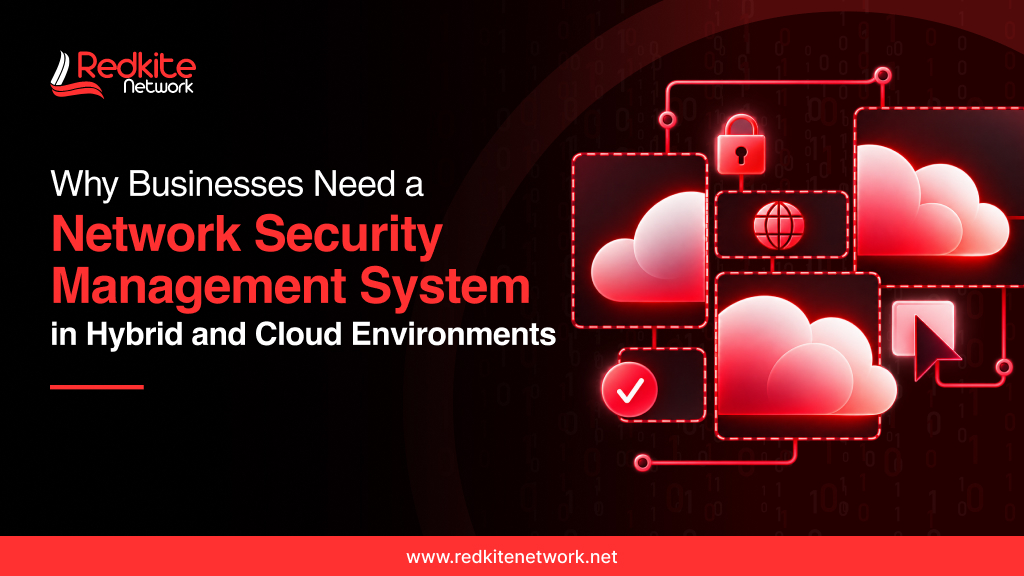
If your infrastructure spans on-premises servers, private data centers, and public cloud platforms like AWS, Azure, or Google Cloud, you’re running a hybrid environment, and hybrid environments can make security gaps harder to identify and manage. A network security management system helps address this by providing a centralized visibility platform to monitor, control, and protect every asset, user, and data flow across that entire footprint, instead of managing firewalls, identity controls, and compliance separately in each environment.
This matters more than ever in 2026. As businesses adopt multi-cloud strategies and hybrid work models, their attack surface expands faster than most internal security teams can manually track. Below, we break down what a network security management system actually does, why hybrid and cloud environments make it necessary rather than optional, and how partnering with an experienced cybersecurity services company closes the gaps most businesses don’t know they have.
What Is a Network Security Management System?
A network security management system is a centralized management layer that unifies the tools your business relies on to protect its infrastructure: firewall management, identity and access management (IAM), endpoint detection and response (EDR), intrusion detection, and cloud security posture management (CSPM). Instead of your security team switching between six dashboards to piece together what’s happening across the network, everything routes into one operational view.
Key areas typically managed include:
- Access: Controlling who can access systems and resources through role-based access and least-privilege policies.
- Traffic: Monitoring network activity for unusual patterns, lateral movement, unauthorized connections, or potential data exfiltration.
- Vulnerabilities: Identifying unpatched systems, insecure configurations, and other weaknesses that could increase exposure.
- Security Policies and Configurations: Establishing consistent security rules, monitoring configuration changes, and identifying configuration drift across environments.
- Compliance: Tracking security controls and configurations against requirements such as ISO 27001, SOC 2, GDPR, and PCI DSS.
For businesses operating a SOC or using SIEM tools, centralized network security management can complement those capabilities by providing greater visibility and consistency across hybrid infrastructure rather than leaving each cloud and on-premises environment to operate in isolation.
Why Do Hybrid and Multi-Cloud Environments Increase Security Risk?
Every major cloud provider operates under its own shared responsibility model, security architecture, and configuration standards. AWS, Azure, and Google Cloud each expect customers to correctly configure identity policies, storage permissions, and network segmentation; none of that is handled automatically. Add on-premises systems into the mix, and your team is now managing multiple, often disconnected, policy sets.
The Cloud Security Alliance names this lack of cross-environment visibility as one of the top hybrid cloud security challenges organizations face today. Every new workload, development environment, or legacy application migration adds another layer of complexity, and without centralized oversight, that complexity compounds instead of resolving itself.
What Happens When Businesses Lack Centralized Network Security Management?
Cloud Misconfigurations Can Increase Security Risk
Misconfigured access policies, exposed storage, excessive permissions, insecure network settings, and improperly configured cloud resources can create security exposure. In hybrid environments, the challenge becomes greater when different teams manage different platforms using different security processes.
Centralized security management can help organizations establish configuration standards, monitor changes, identify deviations, and address weaknesses before they become more significant security issues.
Limited Visibility Can Delay Threat Detection
Security events can originate from on-premises infrastructure, cloud workloads, endpoints, applications, or identity systems. When monitoring data is distributed across separate tools, security teams may need to correlate information manually before they can determine whether activity represents a genuine threat.
Centralized visibility can make it easier to identify unusual activity, investigate incidents, and understand how an event affects different parts of the environment.
Inconsistent Controls Create Security Gaps
When different teams manage different environments without standardized policies, security controls may vary from one system to another. One environment may enforce strict least-privilege access while another uses broader permissions. Firewall rules, logging requirements, vulnerability remediation processes, and configuration standards can also differ.
These inconsistencies are often the result of infrastructure complexity rather than deliberate decisions. A structured network security management approach helps organizations establish common policies and monitor whether those controls remain consistent over time.
What Are the Benefits of a Network Security Management System?
Faster Threat Detection and Incident Response
Centralized monitoring gives security teams a broader view of activity across their infrastructure. Instead of manually reviewing information from multiple environments, analysts can investigate related alerts and events from a more unified operational perspective.
When suspicious activity is identified, this visibility can help teams determine which systems are affected and begin investigation and containment more efficiently.
Centralized Security Policy and Configuration Management
Consistent security policies are particularly important in hybrid and multi-cloud environments. A centralized management approach can help organizations establish security configuration baselines, standardize access policies, monitor firewall rules, and identify configuration changes.
This also helps detect configuration drift, where systems gradually move away from an approved security baseline over time.
Better Compliance and Audit Readiness
Organizations subject to frameworks and regulations such as ISO 27001, SOC 2, PCI DSS, or GDPR need to demonstrate that appropriate security controls are in place and being maintained.
Centralized security management can help document configurations, track policy changes, monitor control status, and identify deviations that may require remediation. This creates a more structured evidence trail than relying entirely on manual spreadsheets and disconnected records.
Consistent Protection Across Distributed Infrastructure
As organizations add new workloads, applications, cloud services, or geographic regions, maintaining consistent security controls becomes more difficult.
A centralized approach can help apply established security policies and configuration standards to new environments while giving security teams greater visibility into whether those controls remain in place.
Better Visibility Into the Security Environment
Managing access, traffic, vulnerabilities, configurations, and compliance through an integrated approach gives security teams a clearer understanding of their overall environment.
This visibility is particularly valuable when workloads and security controls are distributed between on-premises infrastructure and multiple cloud platforms.
When Should Businesses Implement a Network Security Management System?
There is no single point at which every organization must implement a network security management system. The need generally becomes more apparent as infrastructure becomes more distributed, security tools multiply, and internal teams find it increasingly difficult to maintain consistent visibility and controls.
Businesses can start by mapping their current environment and identifying:
- Where security visibility is limited
- Which environments use different security policies
- Where configuration standards are inconsistent
- Which systems lack centralized monitoring
- How vulnerabilities are identified and remediated
- Whether security changes are properly documented
- Which compliance requirements apply to the organization
This assessment can help determine whether existing internal processes and tools are sufficient or whether a more centralized security management approach is needed.
Should You Build In-House or Partner With a Cybersecurity Services Company?
Organizations may choose to manage network security internally or work with a cybersecurity services company, depending on their infrastructure, internal expertise, regulatory requirements, and available resources.
External cybersecurity expertise can be useful when an organization needs specialized support with areas such as cloud security, vulnerability assessments, penetration testing, compliance, security architecture, or incident response planning.
An experienced security partner can also provide an independent assessment of an organization’s environment. This outside perspective may identify configuration inconsistencies, unnecessary security tools, policy gaps, or overlooked attack surfaces that are difficult to recognize when teams work with the same environment every day.
The goal is not necessarily to replace an internal security team. In many cases, an external cybersecurity services company can supplement existing capabilities and provide specialized expertise where it is needed.
How Does RedKite Network Support Hybrid and Cloud Security?
At RedKite Network, we provide cybersecurity services for businesses managing complex network, cloud, and hybrid environments. Our services include governance, risk, and compliance support; network and cloud security assessments; vulnerability assessments; penetration testing; and incident response planning. We also help organizations address security and compliance requirements related to standards and frameworks such as ISO 27001, SOC 2, PCI DSS, and GDPR.
Not sure where your hybrid environment currently stands? Get in touch with RedKite Network for a security assessment that shows you exactly where the gaps are before they become incidents.
Frequently Asked Questions
Q1. What does a network security management system do?
Ans. A network security management system provides centralized visibility and management of security controls across an organization’s infrastructure. Depending on the environment, this can include access controls, network traffic monitoring, vulnerability management, security configurations, policy enforcement, and compliance reporting.
Q2. Why is network security harder in hybrid environments?
Ans. Hybrid environments combine on-premises infrastructure with cloud platforms that may use different security tools, configurations, policies, and management processes. This can make it harder to maintain consistent controls and gain a complete view of security activity across the environment.
Q3. How do cloud misconfigurations lead to security incidents?
Ans. Misconfigured storage permissions, excessive access privileges, exposed services, insecure network settings, and improperly configured APIs can increase an organization’s security exposure. Regular configuration reviews and vulnerability assessments can help identify these weaknesses before they are exploited.
Q4. What compliance frameworks apply to hybrid cloud security?
Ans. Common frameworks and requirements include ISO 27001, SOC 2, PCI DSS, GDPR, and NIST-based security frameworks. The specific requirements that apply depend on the organization’s industry, location, customers, data, and regulatory obligations.
Q5. Can a small business benefit from a network security management system?
Ans. Yes. The appropriate level of centralized security management depends on the size and complexity of the business. Small businesses can also benefit from consistent access controls, vulnerability management, security monitoring, configuration standards, and compliance processes without necessarily building a large internal security operation.
Q6. How does RedKite Network support cloud security?
Ans. RedKite Network provides security services for AWS, Azure, Google Cloud, and hybrid environments. Its services include cloud security assessments, vulnerability assessments, penetration testing, compliance support, and other security services designed to help organizations identify and address security risks across distributed infrastructure.