Modern IT infrastructures are evolving rapidly, moving beyond static firewalls into distributed cloud clusters, hybrid networks, and complex API ecosystems. Yet, relying solely on automated internal security scans can leave important security gaps undetected. While automated scanners are valuable for baseline security hygiene, treating them as a replacement for expert-led evaluations leaves dangerous blind spots.
To secure sensitive customer data and satisfy stringent regulatory requirements, enterprise IT leaders turn to external security partners. Engaging an independent penetration testing service provides an objective, adversarial assessment of your digital perimeter, revealing critical security gaps before cybercriminals exploit them.
Understanding the Difference: In-House Automated Scans vs. Ethical Hacking
Internal IT teams often run scheduled vulnerability scans using automated platforms. These tools cross-reference system configurations and software versions against databases of known vulnerabilities (CVEs).
While automated scanners are quick and cost-effective, they lack contextual intelligence. They generally lack the contextual reasoning needed to chain multiple weaknesses into a realistic attack path or identify sophisticated application-layer weaknesses that may require manual testing to uncover.
| Core Capability | In-House Automated Scanning | Third-Party Penetration Testing |
| Testing Mechanism | Automated signature matching | Human intelligence, custom scripts, manual exploitation |
| Contextual Analysis | Low (High rate of false positives/negatives) | High (Validates real-world impact and business risk) |
| Logic Vulnerabilities | Misses custom business logic flaws | Identifies flawed authorization flows and bypasses |
| Exploitation | Identifies potential vulnerabilities without execution | Safely exploits flaws to demonstrate actual blast radius |
| Compliance Value | Limited in many compliance scenarios | Provides independent testing evidence where required or appropriate |
A professional penetration testing service goes beyond signature checks. Certified ethical hackers employ creative tactics, manual exploits, and targeted social engineering to safely simulate sophisticated, real-world cyberattacks against your environment.
The Operational Limits of Internal Vulnerability Scans
Relying exclusively on internal scans exposes organizations to structural security blind spots:
1. Inherent Internal Bias and System Familiarity
Internal engineering teams build, configure, and manage systems daily. This familiarity creates natural blind spots. Engineers often assume specific security controls work as intended or skip validating secondary interfaces because “it’s only accessible internally.” External security specialists approach your infrastructure without bias, adopting the exact mindset of an outside adversary.
2. Missing Complex Business Logic Flaws
Automated scanners cannot evaluate custom business logic. For example, if a SaaS payment gateway allows a user to modify HTTP request parameters and purchase items at a negative price, an automated tool will mark the endpoint as clean because the code lacks known CVE signatures. Manual human penetration testing explicitly tests these logical boundaries to prevent financial and operational abuse.
3. High Rate of Noise and False Positives
Internal security operations centers (SOCs) are frequently overwhelmed by automated scanner reports listing hundreds of potential threats. Without manual exploitation to verify whether a vulnerability is actually reachable, security teams waste valuable time triaging non-critical issues while missing real exploits hidden in the noise.
Essential Pillars of a Modern Penetration Testing Assessment
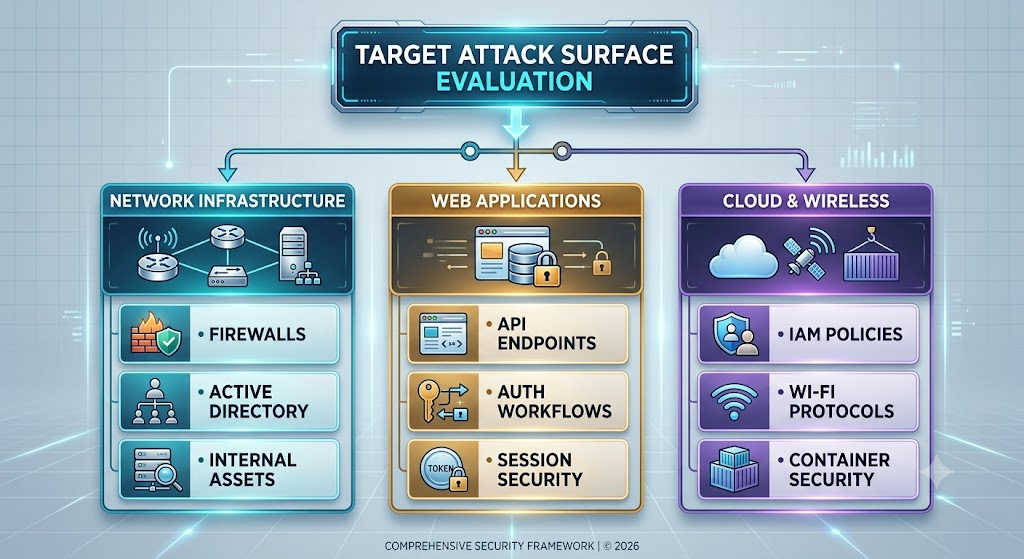
A thorough external evaluation examines every entry point across your attack surface. A comprehensive engagement typically spans three key operational areas:
1. Robust Network Penetration Testing
An organization’s network core remains a high-value target for threat actors seeking unauthorized access. Executing rigorous network penetration testing evaluates internal and external firewalls, router configurations, Active Directory domain controllers, and VPN gateways. Testers identify weak protocol implementations, unpatched network devices, and lateral movement vectors that attackers could use to compromise the entire domain.
2. Specialized Web Application Penetration Testing
Web applications and customer portals handle critical data and interact directly with the open internet. Targeted web application penetration testing focuses on uncovering flaws like SQL injection (SQLi), Cross-Site Scripting (XSS), Broken Object Level Authorization (BOLA), and insecure API endpoints. Because modern applications process sensitive payment and personal data, validating their security posture prevents devastating data breaches.
3. Cloud Infrastructure and Wireless Security Testing
As enterprise workloads migrate to hybrid environments, cloud misconfigurations have become a primary vector for systemic exposure. Depending on scope, external assessments audit identity and access management (IAM) roles, S3 bucket permissions, API management layers, and internal Wi-Fi networks (such as WPA3 enterprise setups) to ensure proper segregation across all cloud and wireless boundaries.
The Business Case: Regulatory Compliance, ROI, and Risk Reduction
Engaging an external security partner provides measurable operational advantages that extend beyond IT departments:
- Supporting Compliance Requirements: Security standards and regulatory frameworks such as PCI DSS, SOC 2, ISO/IEC 27001, HIPAA, and applicable data protection regulations may require or strongly support documented security testing, risk assessments, or independent validation. The exact testing requirements depend on the organization’s systems, scope, and compliance obligations.
- Actionable Remediation Guidance: Rather than delivering an overwhelming list of raw code errors, a third-party penetration testing service delivers prioritized reports detailing real-world risks, clear proof-of-concept (PoC) steps, and practical remediation guidance tailored to your developers.
- Protection Against Ransomware and Silent Compromise: Advanced threat actors deploy stealth tactics to maintain persistence within internal systems. Identifying exploitable pathways before attackers can establish a foothold can reduce the likelihood and potential impact of ransomware, data theft, and operational disruption.
Key Takeaway: In-house automated tools tell you where a door might be unlocked; an external penetration testing service proves whether an attacker can walk through that door, compromise your domain controller, and exfiltrate confidential data.
Partner with Redkite Network for Advanced Defensive Security
Protecting digital assets requires a proactive security approach. Redkite Network delivers specialized security assessments designed around your operational environment. Our team of certified ethical hackers combines advanced penetration techniques with practical, remediation-focused reporting to strengthen your cybersecurity posture against modern threats.
Connect with Redkite Network today to schedule a security consultation and secure your enterprise infrastructure.
Frequently Asked Questions
How often do cyber attacks occur across enterprise networks?
Cyber attacks, automated scanning, and malicious probing against internet-facing systems occur continuously. Attackers and automated botnets routinely scan exposed infrastructure for vulnerable systems, credentials, and services. This is why organizations should combine continuous security monitoring with periodic vulnerability assessments and penetration testing.
Why would a rootkit be used by a hacker during a cyber attack?
Attackers deploy rootkits to hide their presence deep within an operating system’s kernel or boot loader, stealthily maintaining elevated administrative privileges while masking processes, files, and network connections from standard antivirus software and internal monitoring systems.
What is the primary difference between a vulnerability assessment and a penetration test?
A vulnerability assessment is an automated process designed to identify and list potential security weaknesses across systems without exploiting them. A penetration testing service, on the other hand, actively attempts to exploit those weaknesses under controlled conditions to determine the true business impact and depth of a potential breach.
How often should an organization perform external penetration testing?
Industry best practices and major compliance frameworks (such as SOC 2 and PCI DSS) recommend conducting comprehensive testing at least once a year. Additionally, organizations should schedule targeted web application penetration testing or network testing whenever significant infrastructure upgrades, code releases, or network changes occur.
Does hiring a third-party security provider put our production systems at risk?
Professional cybersecurity firms conduct controlled testing following strict Rules of Engagement (RoE). Certified ethical hackers coordinate test timing, scope parameters, and exploit methods with your IT team to ensure all assessments are conducted safely without disrupting live business operations or compromising data integrity.
How does a third-party penetration test support compliance requirements?
Regulatory standards demand objective proof that security controls are effective. Because internal audits carry inherent conflicts of interest, compliance bodies require official reports from independent testing providers to verify that your infrastructure meets industry security benchmarks.