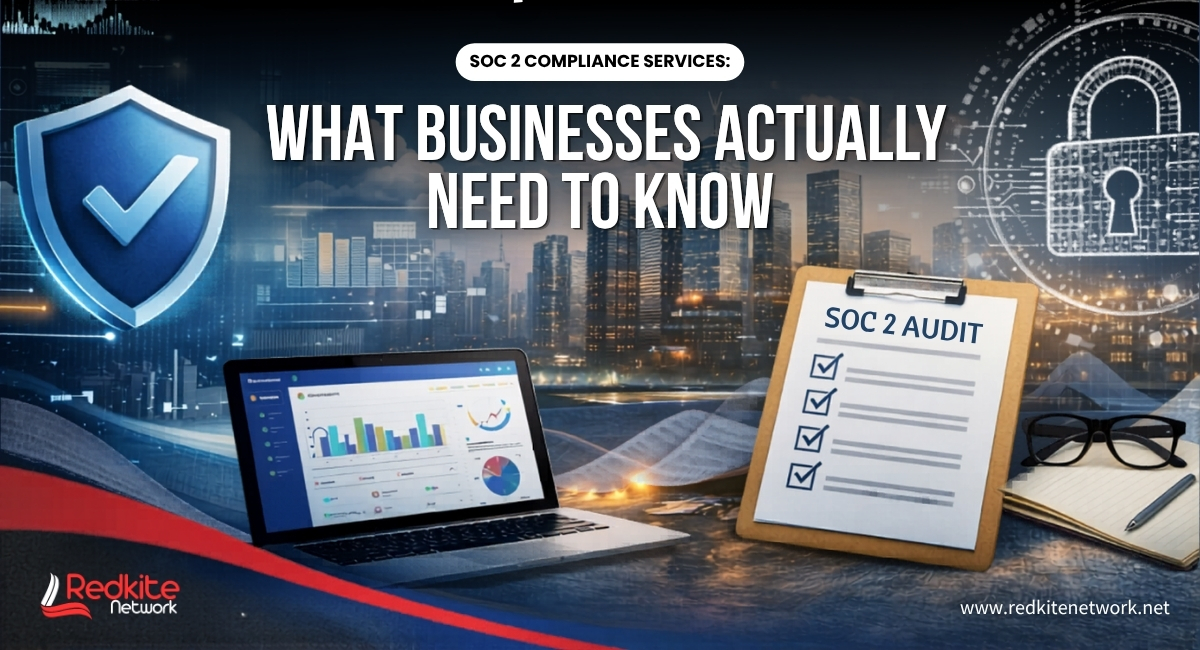
A prospect asks for your SOC 2 report. You don’t have one. The deal stalls – sometimes permanently.
It happens more than most businesses expect. And the fix isn’t complicated – it just requires the right SOC 2 compliance services partner and a clear picture of what the process actually involves.
Here’s exactly that, stage by stage, without the jargon.
So What Actually Is SOC 2?
The American Institute of CPAs created SOC 2 to give businesses a standardised way to prove their data security practices hold up under scrutiny. That’s the short version.
The longer version is messier. Unlike most certifications, there’s no fixed checklist. Your audit gets shaped around your specific business – what systems you run, what data you handle, how your team operates. Two companies can both be SOC 2 compliant and their reports look nothing alike.
That’s partly what makes it hard to prepare for without guidance.
Tech companies, SaaS platforms, and managed service providers are the most common candidates. Usually the push comes from customers, especially enterprise buyers, who won’t sign contracts without seeing a current SOC 2 report.
Which Parts of SOC 2 Apply to You?
There are five Trust Services Criteria. Most businesses don’t need all of them.
Security is the one nobody skips. It’s mandatory across every SOC 2 audit – MFA, encryption, access controls, firewall configuration, the works.
Availability comes into play if your clients depend on your uptime. SaaS companies almost always include this. Disaster recovery, redundancy, whether you’re actually hitting your SLA commitments.
Processing Integrity is less common – mainly relevant to payment processors or companies where accurate data processing is mission-critical.
Confidentiality protects proprietary information. Trade secrets, internal algorithms, commercially sensitive data.
Privacy covers personal data – how it’s collected, stored, used, and disposed of.
Your governance, risk and compliance team should drive the scoping decision. Understanding your SOC 2 compliance requirements before scoping saves time and audit cost down the line. Resist the urge to include everything. Each additional criterion adds audit time and cost.
Type 1 vs. Type 2: The Difference Matters
Type 1 is a snapshot. An auditor reviews your controls as they exist on one specific day and confirms they’re designed correctly. Faster and cheaper. But most enterprise customers won’t accept it on its own because it doesn’t prove your controls actually run consistently.
Type 2 does that. It covers an observation window, typically 3 to 12 months, and tests whether your controls held up throughout. This is the version buyers trust.
A lot of businesses ask whether to start with Type 1 and work up. Honestly? Many skip it entirely. If Type 2 is the end goal, doing Type 1 first just means paying for two audits.
What the SOC 2 Compliance Process Looks Like – Stage by Stage
1. Readiness Assessment
Two to four weeks. A consultant reviews your current setup against SOC 2 compliance requirements and maps the gaps. Some gaps are minor. Some aren’t. Either way, this stage gives you an honest picture before anything else begins.
2. Remediation
This is where the bulk of the work sits and where most timelines slip.
Policies that don’t exist get written. Controls that have been on the to-do list for months actually get implemented. MFA gets enforced for everyone, not just most people. Staff get trained. Evidence collection processes get built.
Three to six months is typical. Companies with stronger foundations move faster. Companies that have deprioritised security for years will sit at the longer end, sometimes beyond it.
3. Evidence Collection
Every control needs documentation. An access review happened? Show the records. Staff completed security training? Produce the completion logs. A system change went to production? There should be an approved ticket for it.
Auditors don’t accept verbal confirmation. If it isn’t recorded, it didn’t happen as far as the report is concerned. Automating evidence collection where possible saves significant time here.
4. Pre-Audit Review
A practice run before the real audit begins. The point is to surface weak spots while there’s still time to address them, rather than seeing them appear as findings in your final report.
5. External Audit
A CPA firm takes over. They review documentation, test controls, and interview staff. Usually two to four weeks. The output is your SOC 2 report.
6. Ongoing Maintenance
The report is valid for 12 months. After that, you go again. Controls need to keep running. Staff need retraining as teams change. Evidence needs to keep being collected. Year-round SOC 2 compliance services support makes this manageable rather than chaotic.
Things That Derail SOC 2 Audits
Overly broad scope at the start. Pulling in too many systems too early inflates the timeline considerably. Focus on your core product environment first. Everything else follows later.
Undocumented controls. A lot of teams say “we do that” and genuinely believe it – but belief isn’t evidence. If a process exists but nobody wrote it down or logged it, the auditor has nothing to work with.
Third-party blind spots. Cloud infrastructure, payment processors, analytics platforms – any external provider touching customer data falls within scope. Their risk profile is part of your audit. Get their SOC 2 reports before yours begins.
Treating it as purely an IT project. HR owns training records. Legal handles vendor agreements. Leadership signs off on policies. SOC 2 cuts across departments – keeping it siloed in IT is a reliable way to create gaps. Good SOC 2 compliance services cover this cross-functional coordination, not just the technical controls.
Where SOC 2 Fits Alongside Other Frameworks
The good news is that meeting SOC 2 compliance requirements often overlaps with what these other frameworks demand – so the work compounds rather than doubles.
ISO 27001 is the closest relative – both focus on information security management, and controls overlap heavily. The main distinction is geographic reach. ISO 27001 is recognised internationally; SOC 2 is primarily relevant in North American markets. Having one in place makes achieving the other significantly less painful.
GDPR is a legal obligation for any business processing data from EU residents. SOC 2’s Privacy criteria aligns with parts of GDPR, but they’re not interchangeable. GDPR compliance is mandatory regardless of whether you pursue SOC 2.
NIST Cybersecurity Framework provides a structure for building security controls. Some businesses use it as the foundation, then use SOC 2 to demonstrate those controls are actually functioning.
PCI DSS applies specifically to card payment processing. SOC 2 Security criteria supports PCI requirements but it’s not a replacement for PCI DSS certification.
Choosing the Right SOC 2 Compliance Services Partner
Experience in your sector matters more than general compliance credentials. A consultant whose background is primarily in healthcare or financial services won’t naturally understand the pressures a growing SaaS company faces. Ask directly about relevant experience before you engage anyone.
Beyond experience, look at what’s actually included. A full-service SOC 2 compliance engagement should cover gap assessment, control implementation, policy development, internal audit support, security awareness training, and post-certification support – not just help getting there.
Talk to their past clients. Ask what went wrong mid-audit and how the team responded. Problems come up on every engagement without exception. The question is whether your partner handles them well.
Ready to Start Your Journey?
SOC 2 isn’t just a box to tick. It’s evidence that your security programme functions the way you say it does – and enterprise buyers know the difference.
Want to know where your business actually stands before committing to anything? Contact Redkite Network for a free consultation.
Frequently Asked Questions
Q1. How long does SOC 2 take from start to finish?
Ans. For a first-time audit, plan for 4 to 9 months. Type 2 adds the observation period on top — another 3 to 12 months depending on what window your auditor requires. Companies with mature security practices already in place tend to move through the earlier stages faster.
Q2. What do SOC 2 compliance services cost?
Ans. Smaller businesses typically spend between $20,000 and $50,000. Mid-size companies usually budget $50,000 to $100,000. Larger organisations can go well beyond that. Costs include auditor fees, consultant fees, compliance tooling, and internal staff time — that last one often gets underestimated significantly.
Q3. Can we get SOC 2 certified without a consultant?
Ans. Technically yes. Most businesses don’t attempt it – particularly on the first audit. Consultants bring templates, auditor knowledge, and experience spotting issues before they become findings. For most companies, the cost saves more time than it adds.
Q4. What’s the difference between SOC 1, SOC 2, and SOC 3?
Ans. SOC 1 covers financial reporting controls – relevant to businesses whose operations affect a client’s financial statements. SOC 2 focuses on security and data handling, and is what most tech companies need. SOC 3 is a condensed, public-facing version of the SOC 2 report – less technical detail, sometimes used for marketing.
Q5. How often does the SOC 2 report need renewing?
Ans. Every 12 months. Second and third audits are generally less intensive than the first – your controls are already built and documented, so the focus shifts to demonstrating continued operation rather than starting from scratch.
Q6. What are the core SOC 2 compliance requirements?
Ans. Every audit must address the Security criterion – access controls, encryption, MFA, incident response, and monitoring. Beyond that, it depends on your business model. Availability applies if clients rely on your uptime. Privacy applies if you handle personal data. Your scope decision at the start determines which criteria and which requirements apply to your organisation.