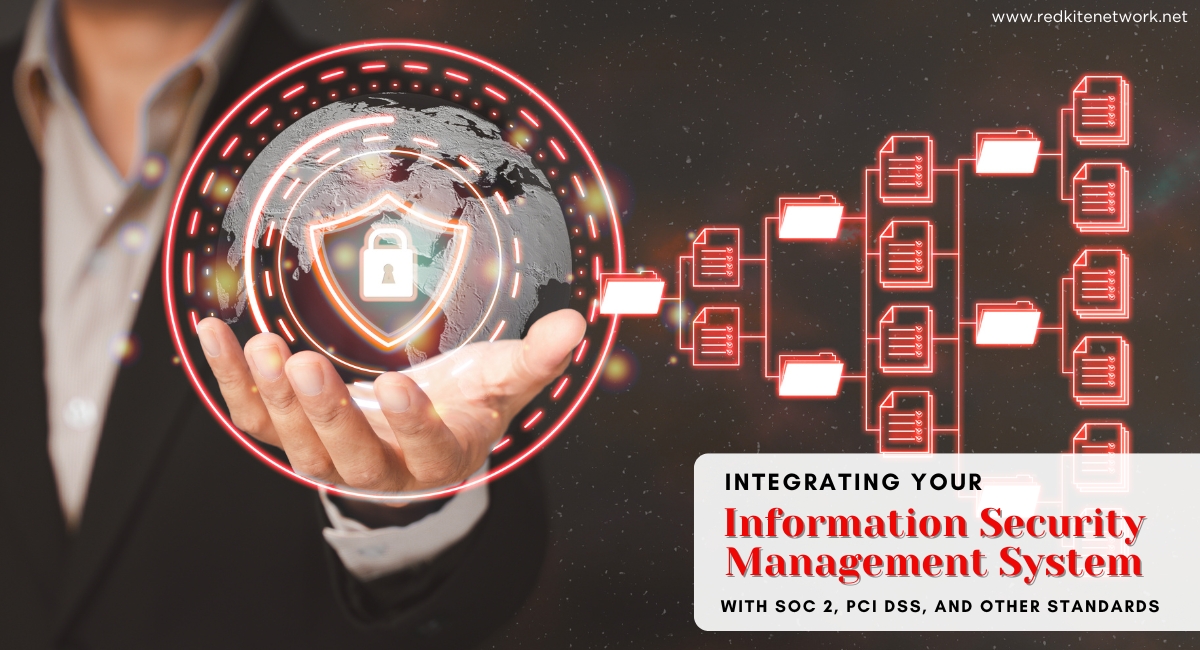
Organisations cannot afford to consider security a one-time project in a world where cyber threats are an order of the day. An information security management system (ISMS) is an organised, recurrent method of disseminating security risk, adhering to requirements, and securing customer information.
Nowadays, a majority of businesses do not simply abide by a single standard. You can be simultaneously working with SOC 2, PCI DSS, ISO 27001, privacy policies, and client-related demands. It is soon complicated, costly and liable to loopholes to manage each one individually.
This is where a unified ISMS is effective. You do not construct individual controls for each framework, but instead construct a centralised security management system and apply several standards to it. The outcome: reduced duplication, improved visibility and enhanced auditable security posture.
The reliance of an Information Security Management System on joining several Standards
When properly implemented, your information security management system will be the base of all security and compliance practices. Instead of being a mere policy document, it is the driver behind the way your organisation manages to identify risks, execute controls and enhance the process.
Basic aspects of an ISMS that facilitate integration
A good ISMS will incorporate:
- Risk assessment and treatment – A formal approach to the process of identifying, analysing, and ranking security risks.
- Policies and procedures – Explicit policies and guidelines on the manner in which security is dealt with and implemented.
- Specified roles and duties – Responsibility for security at every level of the organisation.
- Implementation of control and monitoring – Technical, administrative and physical controls which deal with certain risks.
- Internal audits and management reviews – Continuous review of controls to make certain they are working.
- Continuous improvement – A cycle of incident, metrics and audit review/refinement of the system.
It is these building blocks that frameworks such as SOC 2 and PCI DSS are looking at. You do not need to begin with a blank sheet of paper with regard to every standard, but can instead input their requirements into your current information security framework and trace them to policies, controls and processes that you already have implemented.
Combining SOC 2 and Your Information Security Management System
SOC 2 is concerned with the way your organisation handles customer information in accordance with the Trust Services Criteria: security, availability, processing integrity, confidentiality, and privacy. It does not dictate the use of particular technologies but is very concerned with the operation of your controls in real life. For many organisations, aligning SOC 2 with iso 22301 certification and other resilience standards ensures that both security and business continuity are managed in a unified way.
The points of intersection between SOC 2 and an ISMS
The SOC 2 compliance can be optimised through your information security framework in various ways:
Selection of control using risks
SOX 2 requires you to institute controls that are reasonable for your risk. An established ISMS already has a risk assessment process; hence, it is simple to explain why a particular set of controls was selected and how it reduces the risks that have been identified.
Governance and policy framework.
SOC 2 auditors seek written policies regarding access control, change control, incident response, vendor control and so on. In the event that these are already gathered in your ISMS, you merely demonstrate the connection between them and the applicable SOC 2 provisions.
Evidence and documentation
SOC 2 reports are evidence-based. The logs, records and audit trails are kept in a central location with an ISMS, and therefore, you are not rushing to collect logs at the time of audit.
Ongoing observation and enhancement.
SOC 2 is not a one-point-in-time exercise. A built-in mechanism to show that continued effectiveness is being achieved is presented by your ISMS with its periodical internal audits and management reviews.
By matching SOC 2 controls to the policies, procedures and control library within your information security management system, you are not creating a duplicate program of the SOC 2 program but rather extending what you are already running in your day-to-day operations.
Implementation of PCI DSS in Your Security Framework
The PCI DSS is applicable when you store, process, or transmit payment card information. It is more prescriptive than SOC 2 and puts a lot of emphasis on the environment of securing the cardholder data (CDE).
Making your ISMS the basis of PCI DSS
The following is a way your information security program can achieve PCI DSS compliance:
Definition of scope and asset inventory
An inventory of systems and data flows must already be included in your ISMS. This can be used to form the basis of identifying and segmenting the CDE, which is an important process in PCI DSS.
Matching of technical controls
Some of the controls required by PCI DSS include firewalls, encryption, access controls, logging, vulnerability management and secure software development practices. Such technical controls may be fitted into your main control catalogue and traced back to both risks as well as PCI DSS requirements.
Training, policies and awareness
BI DSS places much emphasis on the safe handling of people’s card data. This is aided by an ISMS with centrally operated policies, compulsory training, and regular awareness programmes.
Incident response and monitoring
Your ISMS can have a clearly defined incident management process that can be expanded to include payment card incidents and achieve the requirements of payment card detection, response, and reporting as per the expectations of the PCI DSS.
When you incorporate PCI DSS requirements in your information security management system, you minimise silos, ensure your approach is consistent, and it becomes easier to have security managed in a holistic manner, as opposed to being a one-off compliance programme.
Mapping Your ISMS to Another Framework and Regulations
In addition to SOC 2 and PCI DSS, the majority of organisations have to deal with other overlapping standards and regulations:
- ISO 27001 / 27002
- Domestic and international privacy regulations.
- Industry-specific regulations
- Vendor risk assessment and client security questionnaires.
Your information security management system can act as a common base, as opposed to developing an individual program in each circumstance, while specialised network security services help enforce the technical controls that support these varied frameworks in practice.
Hands-on measures to develop an integrated compliance map
Develop a centralised control library
Begin with the controls that you have set in your ISMS. Then include fields that align each control to SOC 2 requirements, PCI DSS requirements and other structures. In this manner, a single control (such as multi-factor authentication) can meet a number of overlapping requirements.
Creation of a requirements-to-control matrix
Create an easy matrix indicating:
- The requirement or clause
- ISMS control(s) that relate to it.
- Sources of evidence (logs, reports, tickets, screenshots)
This matrix is very helpful in the audit and assessment.
Normalise your documentation
Standardise policies, procedures and records. Regular documentation can eliminate confusion, as well as enable divergent standards to perceive the same underlying practices.
Align audits and reviews
Instead of running separate internal audits for each standard, plan combined audits where possible. One internal audit of your ISMS can generate findings and evidence that support SOC 2, PCI DSS, and more.
Centralise ownership
Assign a single team or function to coordinate security and compliance. When governance sits inside your ISMS, you avoid conflicting priorities and duplicated efforts.
This integrated approach turns compliance from a burden into an opportunity to improve your overall security posture, making your information security management system a strategic asset rather than a checkbox exercise.
Common Challenges and How to Overcome Them
Even with a solid ISMS, integrating multiple standards can be challenging. Here are some common obstacles and practical ways to address them:
1. Overlapping but inconsistent controls
Different standards may use different terminology for similar requirements, which can be confusing.
- Solution: Normalise language in your control library. Give each control a clear internal name and then note how different frameworks reference it.
2. Evidence gaps and documentation fatigue
Teams often tyre of being asked for “one more screenshot” or report.
- Solution: Automate evidence collection where possible, and clearly define what evidence is needed, how often, and where it should be stored. Integrate this into your ISMS procedures so it becomes routine.
3. Scope creep
As you add frameworks, your compliance scope can expand beyond what is practical.
- Solution: Use your ISMS risk assessment to focus efforts on the most critical systems and data. Define clear scoping rules for each standard and revisit them regularly.
4. Cultural resistance
People may see integrated security and compliance as “extra work”.
- Solution: Communicate the benefits: fewer audits, simpler processes, clearer expectations, and reduced firefighting in the long run. Tie ISMS activities to business outcomes like customer trust and faster sales cycles.
When challenges are addressed proactively, integrating multiple standards into your information security program becomes manageable—and much more efficient than treating each standard separately.
Conclusion
Integrating SOC 2, PCI DSS, and other frameworks into a unified information security management system gives your organisation a single, coherent way to manage security and compliance. Instead of juggling multiple disconnected programs, you build one strong foundation that:
- Reduces duplication and costs
- Simplifies audits and client assessments
- Improves real-world security, not just paperwork
- Scales as your business grows and new standards emerge
With the right guidance, your ISMS can evolve from a compliance requirement into a strategic capability that builds trust with customers, regulators, and partners. If you’re ready to streamline your security frameworks and build an integrated, audit-ready environment, Redkite Network can help you design, implement, and optimize an ISMS that truly works for your business.
FAQs
Q1. What is the main benefit of integrating SOC 2 and PCI DSS into one ISMS?
Ans. You reduce duplication of controls, simplify audits, and manage security through one central framework instead of multiple disconnected programs.
Q2. Do I need a separate team for each standard?
Ans. No. A single governance team can manage multiple standards if they’re all aligned under a well-designed information security management system.
Q3. Will integrating standards make audits more complicated?
Ans. Usually, the opposite—integrated documentation, controls, and evidence make audits faster and more consistent across different frameworks.
Q4. Can I start with one standard and add others later?
Ans. Yes. Many organisations begin with one key framework, then extend their existing ISMS to cover new standards over time.
Q5. How can a partner like Redkite Network help with ISMS integration?
Ans. They can assess your current environment, design an integrated control framework, map it to SOC 2, PCI DSS, and other requirements, and support you through implementation and audits.